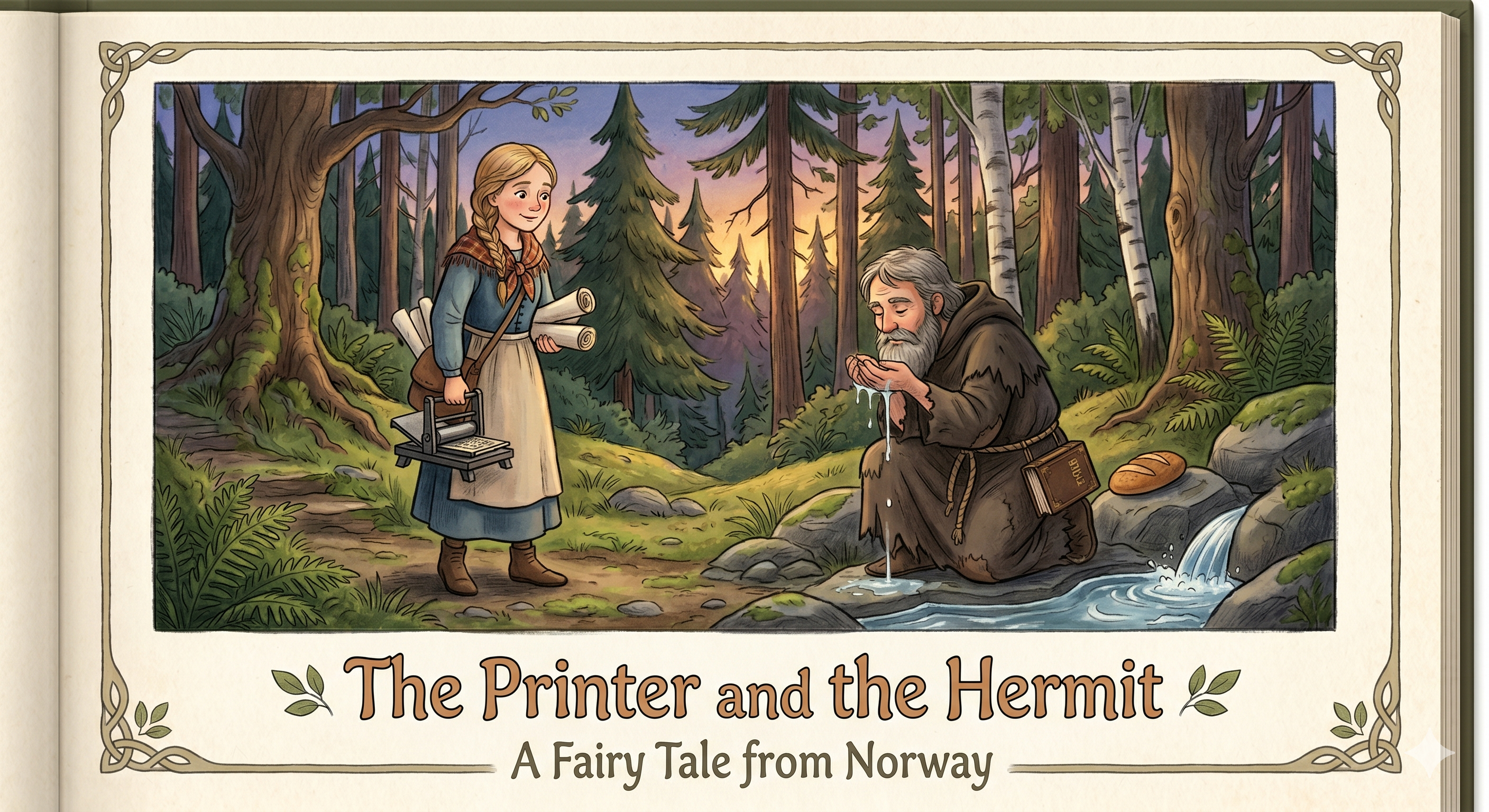
The printing press had not eaten properly for several days. She was greatly exhausted from her long journey through the forest and she feared she might meet a troll. She was not accustomed to deep forests or high mountains, and for the first time in her life she caught sight of a moose.
She knew only the city. The city of Joachimsthal, from which she had set out, where silver coins had once been struck, and Kuttenberg, where silver was mined. Kuttenberg, which had ranked among the wealthiest cities in the world, and whose silver had given the coin called the thaler its very material. Her family was from there; it was there she had learned the craft of the mint. She had journeyed from that distant land all the way here, to Norway.
And just as she stood by the crystal spring and met the hermit, she fell into the deep moss by the spring from sheer exhaustion. She could simply go no further. She had reached the end of her strength, the end of her road.
The hermit, well versed in first aid and healing plants, hurried to her aid. He saw the broken press, worn down by long labour in service of the mighty, yet she still breathed. Gently he lifted her in his strong hands and carried her home.
As he walked, he felt a deep pity for her, and saw in her his own former self, when he had first come to the crystal spring. “They are always the same,” he thought. “One day they will destroy the whole world. Even the bees are dying now.”
For several days the press lay in fever; for several days he kept watch over her, day and night. Outside, a capercaillie was singing when at last she woke.
“Where am I?” the press whispered.
“In safety,” the hermit whispered, and the fire crackled in the hearth.
“You said you had no need of money, and yet you live so humbly?”
The hermit smiled in silence, the smile of one who knows much, who guards the ancient secrets of the north. And he began to sing Jovial by Freddy Kalas.
“Why, you live in a goat shed!”
“This is a modern langhus, my dear,” he replied calmly. “And yes, my animals live with me, so that we may together endure the cold winter.”
“You said you were rich, why did you refuse my money?”
“Your money is only as valuable as people believe it to be.”
“But with it you could buy a palace!” said the press.
“You know, I once wanted money very much. I went to a moneylender for a loan, but I did not have enough even for him to consider it worthwhile.”
“What was it you wanted to buy?”
“A house in the city, and to live there happily.”
“A house where?”
“In the capital, in Bergen.”
“But the capital is Kristiania!”
“Here in Bergen we have our own opinions about that. Are you a Brann supporter?”
“I support Baník, because those lads know how to mine from the depths of the earth. It is a miners’ football club, you see. The silver we use for making money is dug out by miners.”
The hermit thought for a moment, looked the press in the eyes, and said: “Do you know what we have in common? Our clubs both begin with a B.” In truth, however, he said it because he held hard work in the deepest respect. The labour of those who work with their hands with all their strength, to feed their families. He thought of the fishermen who rise every day and sail out to sea, risking their lives. As a boy he would talk with them when they came from the north to sell dried fish in Bergen. That was where he had found his wisdom. The wisdom of the north.
A peace the press had never known before came over her. The hermit’s blue eyes were as deep as the sea and mirrored his good heart. Even though his langhus lay deep in the forest and the fish market was far away, she felt safe there.